Written by Garvit Garg and Stuti Jadaun.
INTRODUCTION
The Kerala Right to Disconnect Bill, 2025 was introduced as a Private Member bill by Dr. N. Jayaraj, chief whip of the state legislature assembly. If the bill is passed, Kerala will become the first Indian state to formally acknowledge an employee’s “right to disconnect,” a concept that has already been accepted in several European countries, including France, Belgium, and Ireland, and is being discussed extensively in international labor forums.
The provisions of the bill would forbid punitive measures like demotion or termination of employees for exercising the freedom to refuse to participate in calls, emails, video conferences, SMS, or other communications outside of their scheduled working hours. In 2018, Supriya Sule, a Nationalist Congress Party MP, proposed the Right to Disconnect Bill in the Lok Sabha. Since the bill was a private member’s bill and no such bill has become an Act in India since 1970, it could not be passed.
Against this backdrop, Kerala’s bill invites a deeper scrutiny. The piece analyses Kerala’s framework through the examination of global developments on the right to disconnect. It brings into the light various shortcomings in the implementation of the proposed right. It examines whether such a right can be effectively incorporated in Kerala’s socio-economic framework without weakening the operational efficiency of industries. Further, various reforms are suggested that are not only pragmatic but also effective in the socio-economic conditions of Kerala.
What is the Right to Disconnect?
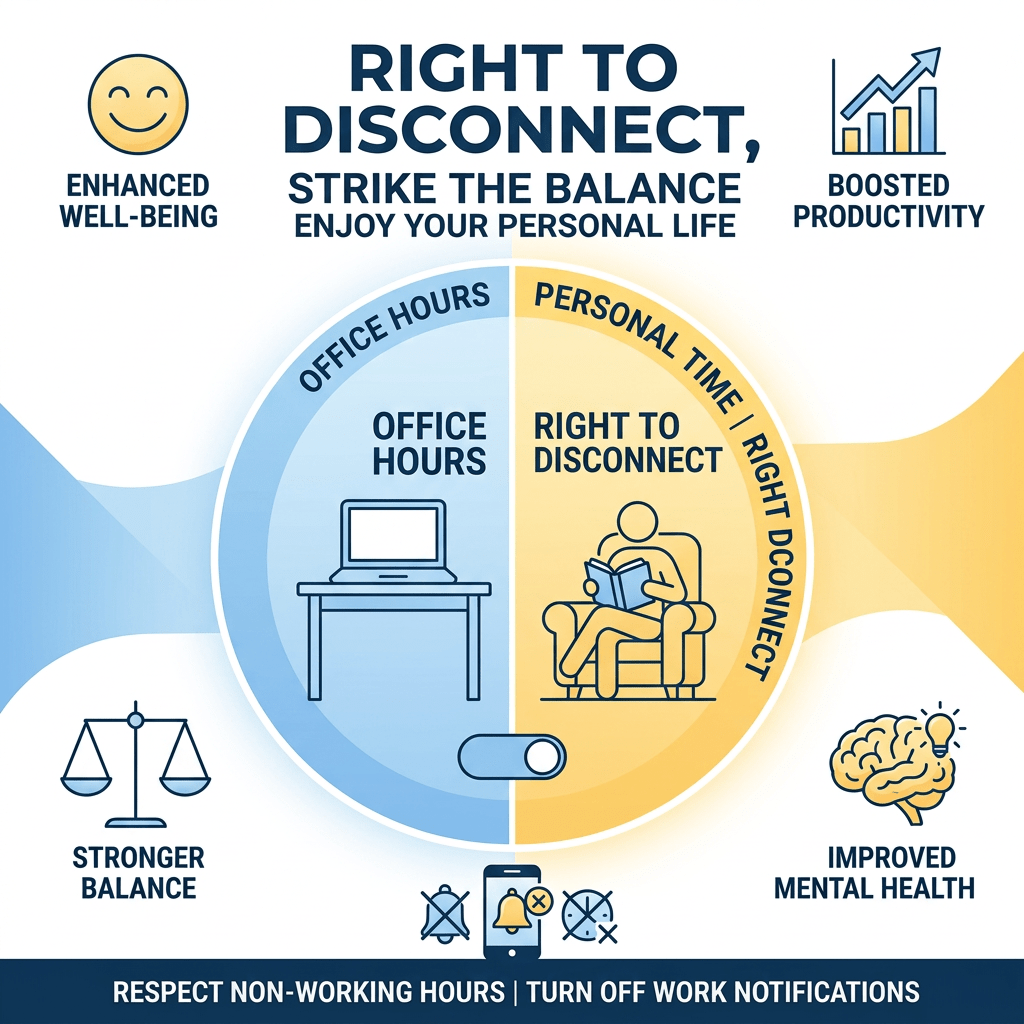
Right to Disconnect is based on the idea that companies should not demand employees to carry out any work-related duties outside their regular working hours. The underlying notion behind this principle is that employees have the right to a personal life, which should not be disrupted by answering messages or finishing projects after they have “clocked out” for the day. This concept finds its origin in Article 24 of the Universal Declaration of Human Rights (UDHR), which stipulates that “Everyone has the right to rest and leisure, including reasonable limitation of working hours and periodic holidays with pay.”
Global Experiments with the Right to Disconnect: Lessons from France, Australia, and Belgium
In the twenty-first century, the right to disconnect has become more prevalent, especially in light of the growth of digital communication technologies, because digital tools have blurred the boundaries between working hours and private time. With the passage of its El Khomri Law in 2017, France became the first nation to explicitly recognise this right, positioning itself as an early regulatory responder to digital labour concerns rather than merely acknowledging a social demand. Spain, Italy, Belgium, Portugal, Ireland, and Australia are other nations that have adopted such laws or policies after France. French law obligates companies with more than 50 employees to establish policies around work communication that clearly define typical working hours. Additionally, it also entitles employees to overtime compensation. However, in a 2023 poll the French company OpinionWay discovered that around 55% of workers accessed their work emails while on vacation, while 27% of French employees reported working remotely.
In Australia, the right to Disconnect is a ‘workplace right’ under the Fair Work Act 2009, thereby embedding it within an adjudicatory enforcement framework rather than a purely policy-based obligation. This protection covers all attempts at contact, and employees are not obliged to keep an eye on, read, or reply to communications sent after hours. But in sharp contrast to the 15,000 unfair dismissal claims filed each year, as of February 17, 2025, only four applications on the Right to Disconnect have been submitted to the FWC, which indicates limited awareness, hesitation of employees to litigate, or structural enforcement barriers. This begs the question of whether workers are reluctant to use their rights, are unaware of them, or encounter enforcement challenges. Similarly, in Belgium, the Right to disconnect is covered in a law called the “Act regarding the strengthening of economic growth and social cohesion.” The statute requires companies with more than twenty workers to meet with the workplace health and safety committee to examine disconnection and the use of digital technologies. These clauses were designed to protect workers’ time off, rest periods, and to maintain balance between their personal and professional lives. However, employees in Belgium are not entitled to disconnect in the technical sense of the word. After conferring with the committee, the employer may, but is not obligated to, implement disconnection policies, therefore leaving implementation largely discretionary. Additionally, the regulation does not specify how frequently the employer must meet with the committee.
This comparison of the right to disconnect across different jurisdictions demonstrates that acknowledgement of this right is a major step forward in employee protection,but when we see this in light of enforcement structures, cultural practices, and employer discretion, recognition alone cannot ensure effective implementation. Its practical use is constrained by structural disparities, limited cognizance and inadequate implementation in the workplace, because formal rights without accessible mechanisms of enforcement can remain largely symbolic.
Assessing the feasibility of right to disconnect in Kerala
The traditional way of doing work substantially changed after the pandemic. The work no longer has fixed hours, and there has been a surge of hybrid and remote models, which have blurred the line between work and rest. In a report, it has been found that around 28.2% of employees have adopted a hybrid work model. It has been recognised by various organisations that flexibility and real-time communication form the linchpin of productivity. The Right to Disconnect Bill proposes restrictions on after-hours communication, which is seen as an impediment to digital globalisation of work.
Kerala has been evolving as one of India’s digital economies. It has ranked 8th in the country in software exports from the software Technology Parks of India. Kerala is a hub of Technopark, Infopark and Cyberpark, which collectively build the state’s digital infrastructure. Technopark houses over 53,000 professionals, while Infopark employs 70,000 IT/ITeS professionals. Infopark accommodates around 582 companies, and Cyberpark houses 82 companies. These Companies are steadily expanding their business. HCL Tech, a leading global technology company, recently arrived in Kerala, which has operations around 60+ countries and employs over 223,000 professionals. The data above reflects the widespread IT landscape of Kerala and the global operations of the firms established in the state. The working and productivity of these firms depend on real-time communication where clients and employees are situated in different countries with distinct time zones. The Right to Disconnect Bill seeks to prohibit work-related communication after fixed working hours. It fails to recognise the practical reality of digital globalisation, which necessitates flexible communication between clients. Further, if implemented, it can compromise the operational efficiency of global industries.
Kerala’s workforce is already governed by various legal frameworks that regulate the working conditions and employee welfare, which make the “Right to Disconnect bill redundant. Section 6 of the The Kerala Shops and Commercial Establishments Act requires defined working hours for employees with rest periods in between. This legislation directly addresses work-life balance by not allowing the employee to work for extended hours beyond their work limits. In addition to this, provisions of the Central Labour Codes, such as section 13 of the Code on Wages and section 25 of the Occupational Safety, Health, and Working Conditions Code, which standardise working-hour rules, further reinforce these rights at the national level. These regulations govern working hours in India and enforce compliance through digital monitoring by state governments.
Introduction of a separate “Right to disconnect” bill could create ambiguities for employers, especially in the IT/ITeS sector and can further create inconsistencies between state laws and central laws.
REFORMS: A Tailored Right to Disconnect Framework for Kerala
The complex nature of the employer-employee relationship can make the implementation of the right to disconnect challenging. This right should not postulate the blanket prohibition of after-work communication, as the degree of intrusion depends on the mode of communication. An email addressed to an employee after working hours may not demand an immediate response, while a phone call or WhatsApp message may cause direct intervention during rest. Hence, the legal framework concerning Right to Disconnect must differentiate among different modes of communication. The content of the communication should also be determined while restricting to after-work hours communication. The law must distinguish between an important professional communication and an unwarranted intrusion into personal time.
To implement the Right to Disconnect while taking into account Kerala’s IT-driven economy, inspiration can be drawn from Australia’s Fair Work Amendment (Right to Disconnect) Bill 2023. According to the Australian Fair Work Ombudsman, employees have the right to refuse to read or respond to any contact made after working hours. But as per the provisions, the refusal would be subjected to the test of reasonableness, i.e., the refusal should not be unreasonable. The reasonableness is determined by various factors, such as the purpose and urgency of communication, the employee’s role and responsibility in the organisation, personal circumstances, etc.
For Kerala’s economy, this approach can be adopted, considering the significant portion of the workforce employed in multi-national and IT companies. The addition of a clause on reasonableness in the proposed bill can ensure employees’ well-being while simultaneously addressing the need for real-time communication in the IT-driven world. It will also ensure the continuity of global business across multiple time zones.
Countries like Australia, France, and Belgium have introduced and implemented the Right to Disconnect; however, their experiences have reflected the issue of a lack of awareness and weak enforceability. Kerala’s proposed bill, thus, must go beyond formal recognition of the right. It should make the right properly enforceable through awareness programs in respective institutions, digital monitoring and clear criteria.
CONCLUSION
The Kerala’s Right to Disconnect Bill is an important development in contemporary employment legislation, particularly in a time when digital communication technologies have left no space between professional and personal life. However, the worldwide experience from the French revolutionary framework to the Australian unique model and Belgium’s participatory method demonstrates that mere statutory recognition does not ensure successful enforcement. Practical challenges, such as inadequate awareness and structural weakness, have often mitigated the impact of these policies. Kerala’s situation presents its own unique challenges. Being a fast-digital economy, the state relies heavily on real-time communication across different time zones; thus, a stringent ban on post-hours contact can destabilise work efficiency and global operations. Therefore, the route forward is to adopt foreign models thoughtfully rather than simply replicating them. A balanced strategy, such as the addition of a reasonableness provision etc. will not undermine employee welfare at the expense of the business requirements. Finally, Kerala’s Right to Disconnect must seek to reconcile the employee’s right with the globalised, digitally linked economy.

 Global Business Law Review
Leave a comment